
Previous Residents at a Burbank Address
A house-history search for previous residents needs an era plan before it needs a name search. Recorded deeds can establish legal transfers from 1851 forward, but their index is searched by person and year at Norwalk. Regional city directories and reverse volumes can place a listed occupant in an annual or near-annual snapshot. The federal census covers households through the public 1950 schedules, while local newspapers and permits fill narrower events. No single source spans all of Burbank's address history.
| Source | Years it covers | Where held | What it shows |
|---|---|---|---|
| Recorder deeds | 1851-present | RR/CC Norwalk index and copies | Owners, parties, legal land, recording data |
| Reverse directories | 1906, 1927, 1956-1987 | LAPL and ResCarta | Listed occupants by street and number |
| City directories | Regional 1875-1987; coverage varies | LAPL digital and library holdings | Names, addresses, household clues |
| Federal census | Public through 1950 | NARA and library databases | Household members and relationships |
| Burbank permits | Dates vary by series | City portal or counter | Building work and project parties |
| Local newspapers | 1931-2008 local microfilm | Burbank Public Library | Obituaries, moves, events, notices |
| Sanborn maps | Edition-specific; catalog dependent | LOC and library databases | Footprint, use, material, address context |
Start with a current parcel for a recent address, a deed or directory for a mid-century question, and census or regional directories for an older household. Keep the collection's exact coverage beside the result because Burbank inclusion varies volume by volume.
Burbank Deed Records: 1851 Baseline
Los Angeles County RR/CC states that real-estate records run from 1851. The index is not online for public browsing. Researchers search alphabetical grantor and grantee indexes by name and recording year at 12400 Imperial Highway, Norwalk CA 90650. Review of 1851-1957 records is on the lower level, while 1958-present is on the second floor. This physical split is an access detail, not a break in the chain of title.
For previous residents, the county's policy is the central Burbank records quirk. Concern about exposing protected officials' home addresses and Government Code §7928.205 support withholding the web index. Telephone staff at (800) 201-8999 can explain procedure, but the county does not accept a telephone index search. Bring spelling variants, approximate year, spouse, trust or business names, and the AIN or legal description.
The RR/CC real-estate records guidance explains the in-person index route. Known documents can be ordered online, by mail, fax, or at the counter; the published online estimate is within 20 working days, with fees checked at order time.
Walk Burbank Deed Records Backward
A deed chain moves from a current parcel clue to a name, then from one seller to an earlier buyer. Use the Assessor address search to obtain the AIN, legal description, and current assessed owner clue. Search that current owner as grantee around the likely acquisition year. The instrument supplies the prior grantor, recording date, document number, and legal description. Search the grantor as grantee in earlier years and repeat.
- Save the current AIN, situs, legal description, and any public assessment detail.
- Use Burbank permits to note construction, remodels, old permit numbers, or a legal description.
- At Norwalk, search the current owner as grantee by approximate year.
- Read the instrument and record grantor, grantee, date, legal land, and document number.
- Search the prior grantor as grantee, including trust, corporation, spouse, and spelling variants.
- Grantor
- The party transferring or conveying an interest in the recorded instrument.
- Grantee
- The party receiving the interest in that instrument.
- Chain of title
- The linked sequence of recorded transfers for the same legal parcel.
- Legal description
- The surveyed land description that can remain stable when street wording changes.
Ownership and occupancy are separate chains. Deeds show legal transfers. Directories and census schedules show listed or enumerated households. A past owner may not have lived at the address, and a listed occupant may not have owned it.
Burbank Resident History at the Library
Burbank Library's local-history guidance joins the Assessor's construction date, description, and AIN with city permits, Public Works maps, Sanborn maps, directories, and newspapers. The path is useful when the address has a visible building history but the people trail is thin. Start with the AIN and legal parcel, then add the permit number and any old address form found in a directory.
The library's staff search is most concrete for obituaries. Give an exact death date, and staff can search ten days of local newspaper microfilm for a Burbank resident. The Burbank Daily Review covers 1931-1985 and the Burbank Leader 1985-2008. A death notice can identify family, a service, or a former address, but it remains a newspaper source and should be confirmed through a vital or probate record.
Use the Burbank Library house-history and local-history page for the service route. Send requests to burbankhistory@burbankca.gov. Library staff and the Burbank Historical Society's Gordon R. Howard Museum can add photographs, ephemera, and local context, but private membership lists are not a substitute for a public record.
The current municipal fallback is described on the Burbank public-records portal restoration notice. Preserve a permit or document number when the online route changes.
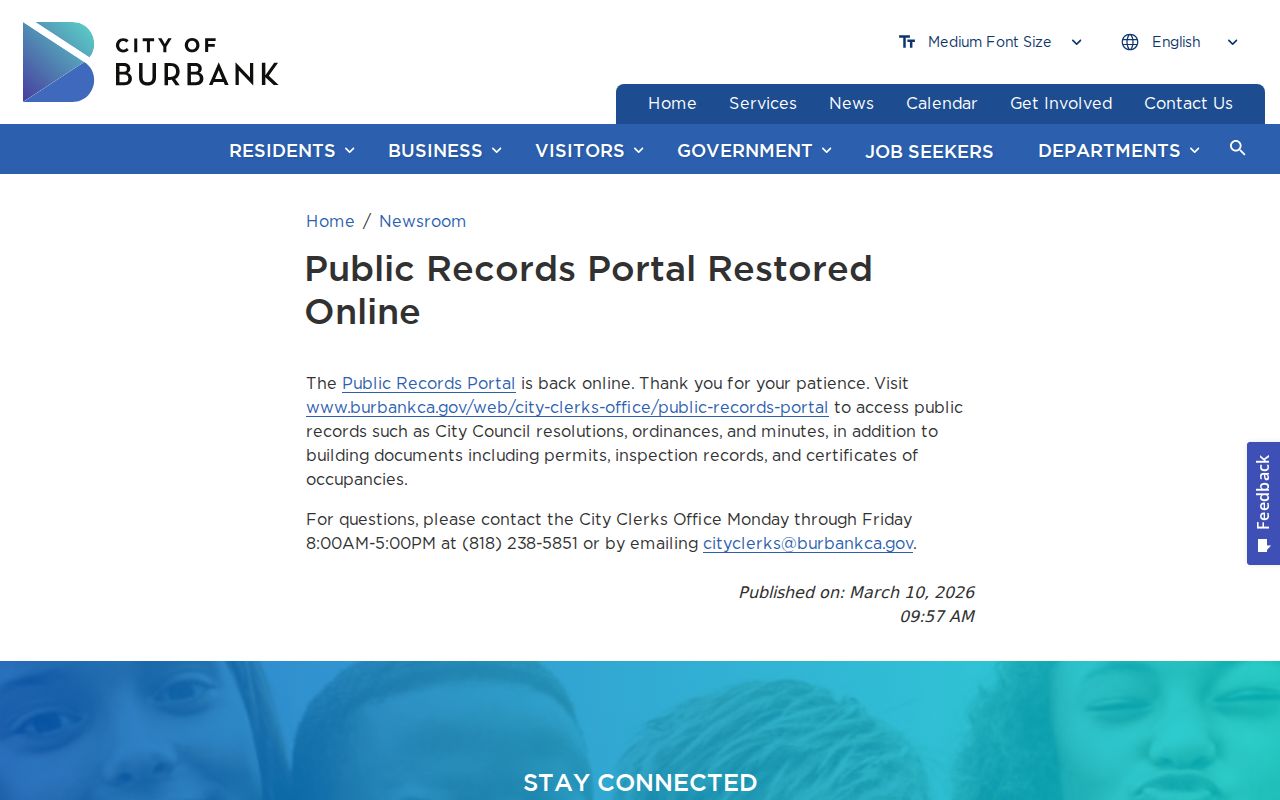
The city portal capture is a timely reminder that a digital outage does not erase the underlying municipal record.
Burbank Property Records and Sanborn Maps
Sanborn fire-insurance maps can show a building footprint, use, construction material, and address context. They are not resident rolls. The exact Burbank edition list remains a catalog question, so search the Library of Congress guide and the library's database for “Burbank, Los Angeles County, California” before stating a year. Compare the map's street, lot, and structure with the current parcel and legal description.
The Library of Congress Sanborn search guide explains catalog and map searching. A map can reveal that a structure or street form changed, which helps explain why a directory entry appears to vanish. A permit can then provide a project date or named party. Neither source proves who occupied the building at that moment.
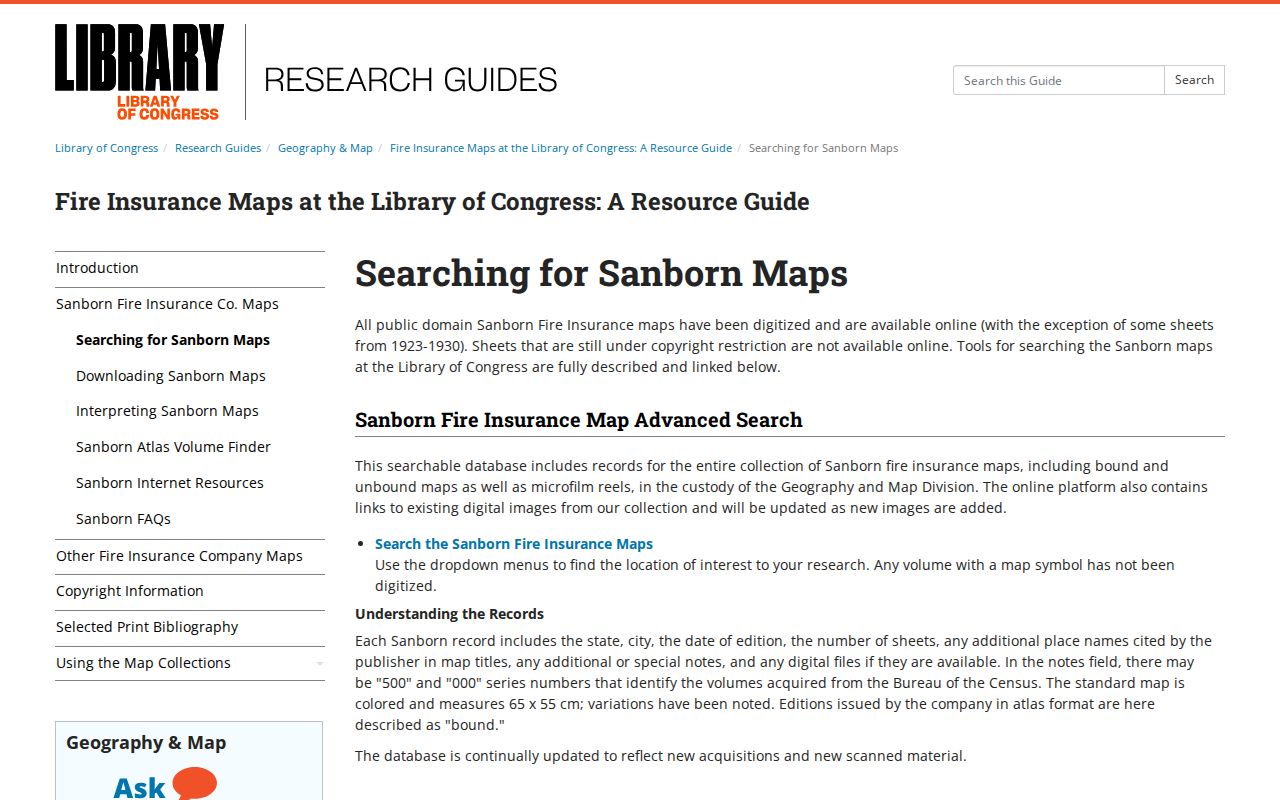
The map capture belongs beside the parcel and permit records, where the physical story and the household story can be compared without blending them.
Find Burbank Previous Residents Between Deeds
Recorded transfers can be years apart when tracing previous residents. Reverse directories fill some of the gap with a street-ordered name, while alphabetical city directories add spouse, occupation, telephone, and address marks. The LAPL regional city and street-address run reaches 1875-1987, with reverse volumes listed for 1906, 1927, and 1956-1987. Check the volume for Burbank inclusion before treating a gap as an absence.
Pair a directory year with a federal census year. The census is public through 1950 under the 72-year rule and can show household members and relationships, but an enumerated address can be hard to match when a street or district shifts. Keep the source's name, year, address, and page. Then search local newspapers for an exact death date or a move notice.
Search conventions matter. LAPL notes that a reverse address may require a literal h householder prefix, and numbered streets can appear in more than one written form. A failed text search should lead to page browsing, not a conclusion that the address had no household.
Burbank Past Residents: Directories and Census
Previous residents are often found as a sequence of snapshots. A directory lists a surveyed subscriber or householder. A census lists the people counted in a household. A newspaper notice may describe a death or community event. Probate can name an estate's petitioner and heirs. Match the address, year, spouse, middle name, occupation, and source role before deciding that two entries describe the same household.
For collection details, use the Burbank city directory page. It owns the publisher, year, shelf, reverse-volume, and entry-reading work. The current parcel and named-street chain belong on the Burbank street directory page. The backward trail stays centered on one address moving through time.
When a person disappears, possible explanations include a move, death, unlisted status, a publisher gap, or a change in community coverage. A first or last appearance brackets a period; it does not give an exact move date.
Bridge Burbank Property Records Across Addresses
Burbank incorporated in 1911, so pre-1911 municipal records are not a simple city series. Search county deeds, courts, census geography, regional directories, and newspapers for the earlier period. After incorporation, city permits and municipal proceedings add context, but the county remains the land-title custodian. The old and new address forms should be stored together.
Use Public Works address and tract maps, parcel maps, permit legal descriptions, Sanborn sheet indexes, and the AIN to bridge a street-name or number change. Research did not verify a complete official Burbank-only renumbering table, so a missing text match should be reported as unresolved until a map or legal parcel connects it. A legal description is often the best continuity anchor.
The Superior Court Archives and Records Center is another historical channel. It is at 222 N. Hill Street, Room 212, Los Angeles, with weekday hours 8:30-4:30 and (213) 830-0198. It mainly holds many 1910-2004 unlimited civil, family, felony, probate, and juvenile files. Call about a specific case because coverage varies by type. The court Archives and Records Center page gives the official access details.
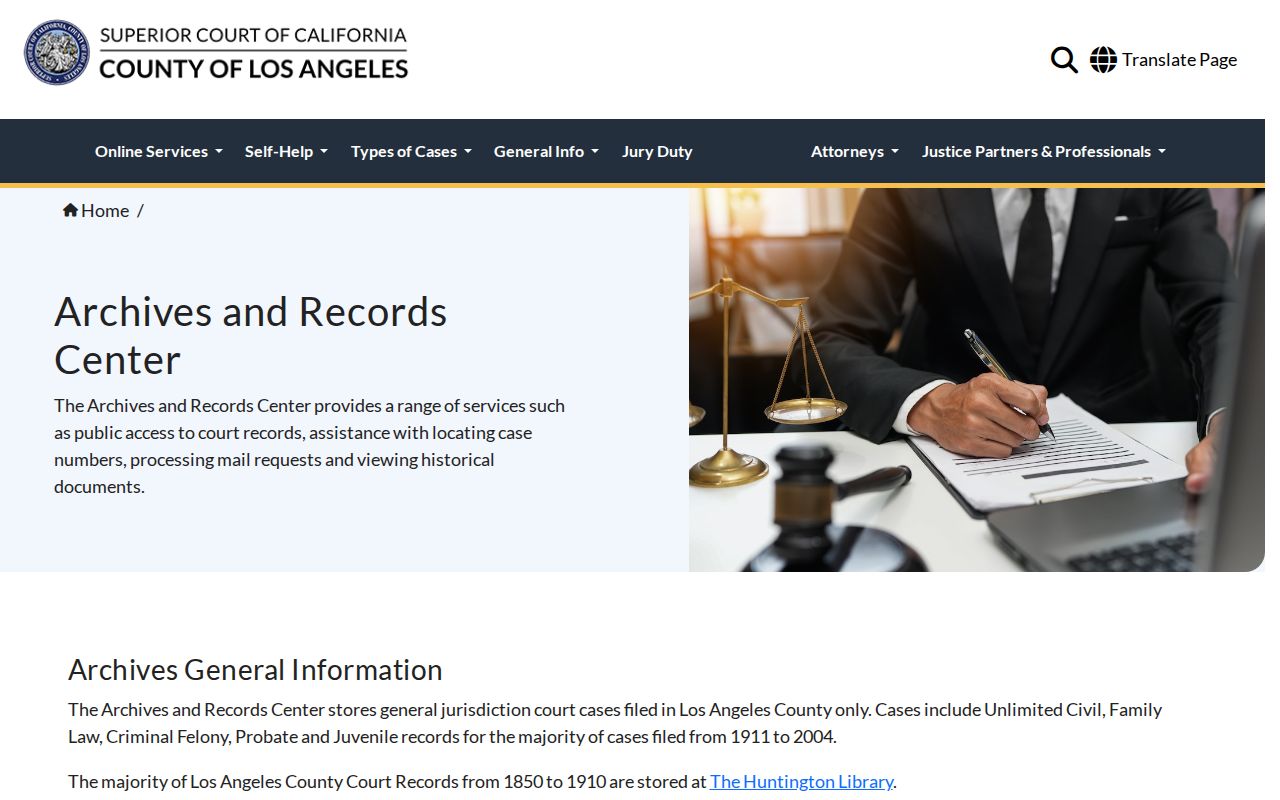
The ARC image is a reminder that older probate or court context may require a terminal, paper file, or clerk copy rather than a modern web result.
Burbank Previous Residents: Close the Trail
Obituary and probate records can close a historical trail, but each has a defined scope. Burbank Library needs an exact death date for its ten-day local-paper search. The county and CDPH issue death copies under authorized or informational rules. Superior Court probate can expose public filings while protecting confidential material. A deed can identify an estate or transfer without proving the decedent lived at the parcel.
For records not online, use the custodian's counter, mail, phone, or request route. RR/CC can answer recorder procedure at (800) 201-8999, but not conduct a telephone address search. The city accepts focused California Public Records Act requests for identifiable municipal records. The California State Archives county-records catalog, LAPL, Burbank Library, and established genealogy databases can supply finding aids, but a derivative should lead back to the original office. RR/CC also published a replacement-records advisory for qualifying fire-impacted residents; use the official notice only when its eligibility fits.
Lawful use. Previous-resident research is for house history, family history, estate work, and personal curiosity. Do not use it to track, stalk, harass, threaten, or harm a living person.
Keep the AIN, instrument number, permit number, directory year, page image, and case number in the final notes. Those anchors make the story checkable when a name or address appears in more than one era.