
Burbank City Directory Collections
The main Burbank directory trail sits in Los Angeles-area collections. LAPL's city and business runs reach 1873-1970 in digitized material, with hard-copy Los Angeles volumes from 1873-1942. The wider digitized city and street-address collection spans 1875-1987. Reverse directories appear for 1906, 1927, and 1956-1987. These dates describe verified regional runs, not a promise that every volume includes Burbank. Inspect the title, place list, and scan before relying on a negative search.
| Collection | Years | Where held | Access |
|---|---|---|---|
| Historic city and business directories | 1873-1970 digitized; 1873-1942 hard copy noted | LAPL History & Genealogy | Digital and reference use |
| Los Angeles street or reverse directories | 1906, 1927, 1956-1987 | LAPL and ResCarta | Browse by street or address |
| Digitized LA-area city and street-address run | 1875-1987 | LAPL Digital Library | Free online collection |
| U.S. city-directory microfilm | 1861-1960; 5,000-plus rolls | LAPL History & Genealogy | Reference and library access |
| Burbank local newspapers | 1931-2008 on two local runs | Burbank Public Library | Staff request and microfilm |
Multiple publishers appear across the shelf, including Los Angeles annual directory titles, Maxwell's, Smith & McPhee, and telephone publishers. Missing years can reflect collection gaps, changing coverage, publication pauses, or a volume that did not include the community. Record the exact title and year along with the result.
Burbank Directory History Shelf
The Burbank Public Library local-history service is the best local first stop for a directory question that also involves newspapers, obituaries, or house history. Staff search Burbank Daily Review microfilm from 1931-1985 and Burbank Leader microfilm from 1985-2008. An exact death date allows a ten-day search window after the death. The service can also check the historic Los Angeles Times run from 1881-1987 and the later newspaper database described by the library.
Requests go to burbankhistory@burbankca.gov. Ask for a name, exact date, likely address, spouse, organization, and the kind of notice sought. Local film lacks a broad name index, so a date is the key that makes staff work possible. A newspaper notice is a finding aid. Confirm a death, marriage, ownership transfer, or heir relationship with the county, court, or state custodian.
The Burbank Library local-history page also points researchers to assessor construction facts, permits, directories, newspapers, and Sanborn maps for house history. Its staff service is a separate access channel from the LAPL digital collection.

The local-history capture shows why a historical directory search can be paired with a newspaper request rather than treated as a stand-alone name lookup.
Browse the Digitized Burbank Directory Run
The LAPL digitized city and street directory collection is the main online route. It covers Los Angeles-area name and address volumes from 1875-1987 and lets a searcher move between alphabetical and street-address patterns where the scan supports it. Search results should be checked in the page image because optical character recognition can miss initials, abbreviations, punctuation, and numbered-street forms.
A negative result can mean the volume omitted Burbank, the street was indexed under a variant, the page is not OCR-friendly, or the household was not listed. Read the volume's introduction and coverage notes first. Save the scan page, printed title, publisher, year, and the exact entry rather than only a typed transcription.
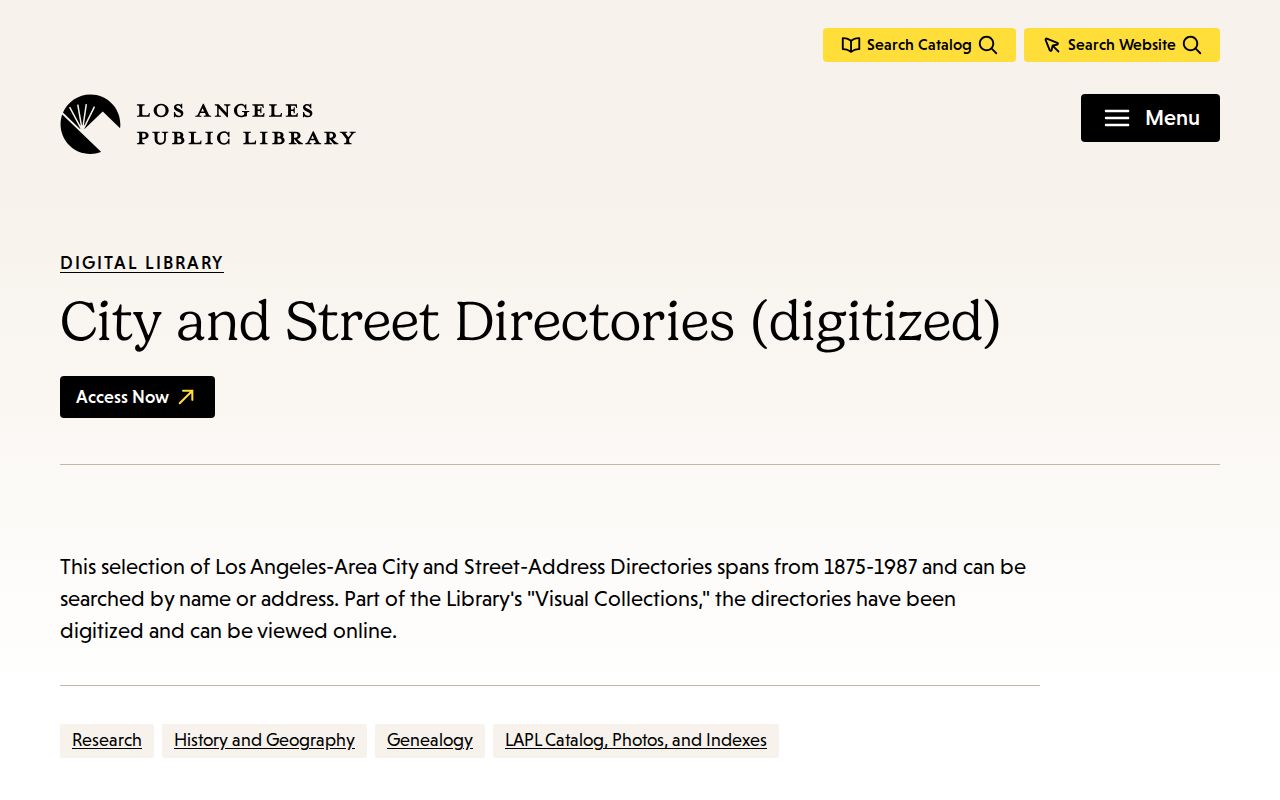
The digitized collection is useful for a year-by-year household trail, but a modern address question belongs with the parcel and deed workflow on the Burbank street directory page.
Burbank Reverse Directory Years
Reverse directories change the order of the search. Instead of starting with a surname, browse the street, number, and listed subscriber. The verified regional reverse runs include 1906, 1927, and 1956-1987. A volume may place Burbank pages among Los Angeles County communities, so confirm the place label for the year under study.
LAPL's ResCarta browse screen is valuable when a text search does not behave as expected. One local search quirk is the householder prefix: an address may need to be entered as h443 ... rather than 443 .... Numbered streets can appear as “Ave 64,” “Avenue Sixty-Four,” or a neighboring ordering, and abbreviations such as “Bway” can vary. Browse the scan when the typed search fails.
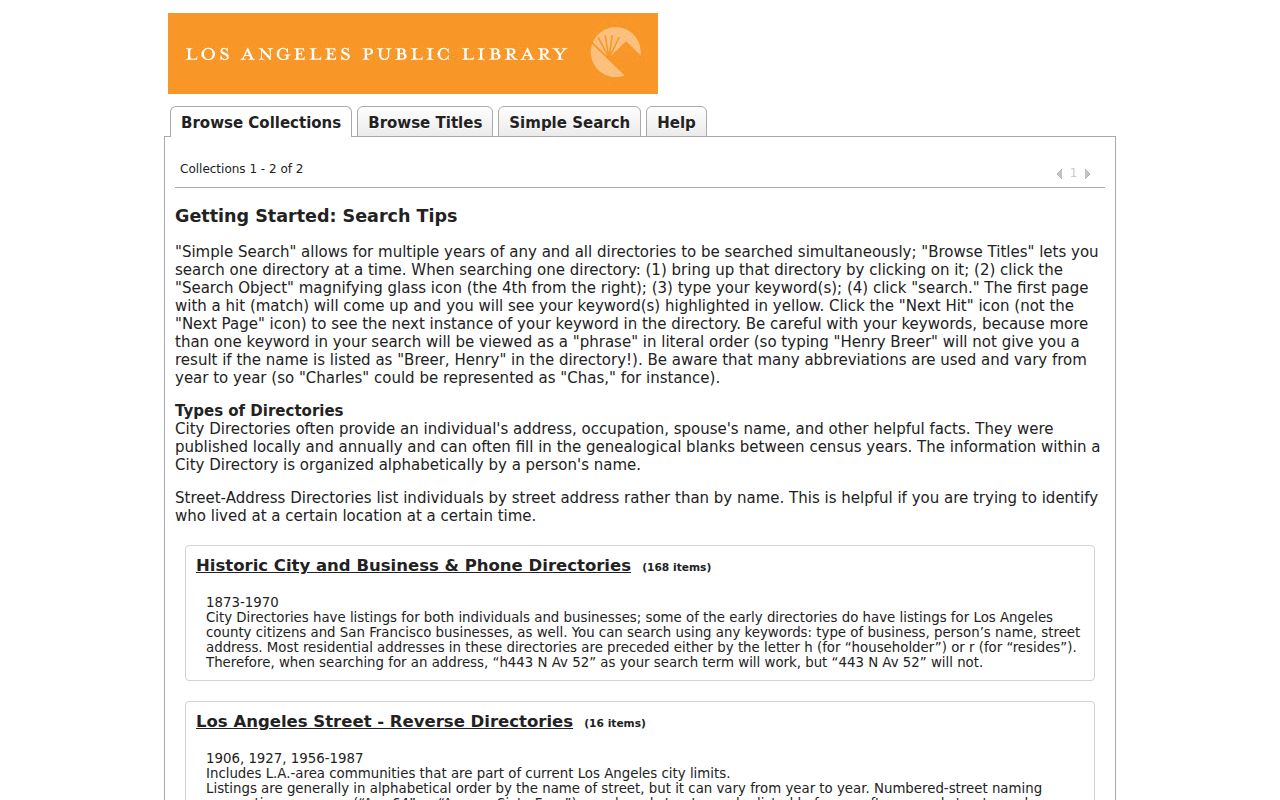
The LAPL ResCarta collection browser is the source for the reverse-directory capture. Photograph or note the abbreviation key before reading a long run.
Reading a Burbank City Directory Entry
An entry is a compact statement about how a publisher surveyed a place. It may include a surname and given name, spouse in parentheses, occupation or employer, street address, telephone number, and a mark such as “h” for householder or “r” for residence. Business entries can name a firm, principals, category, and address. Later reverse sections may list the occupant and phone under the street and house number.
| Name | Person as printed, sometimes with a spouse or household relationship. |
|---|---|
| Occupation | Work or employer as reported by the directory publisher. |
| Address | House number and street, with local abbreviations and directional forms. |
| Householder mark | “h” can identify a householder; “r” can indicate residence in some runs. |
| Telephone | Later volumes may list a number or exchange, which can help compare years. |
- Criss-cross directory
- A street-order directory that turns an address into a listed name.
- Householder index
- A name or address aid that points to the person treated as the primary household entry.
- Abbreviation key
- The volume's explanation of street, occupation, marital, and residence marks; find it before interpreting an entry.
Do not expand an abbreviation by guess. Compare the same publisher's key, neighboring entries, and a second source. A directory lists a surveyed subscriber or householder, not every person who slept at the address.
Burbank City Records After 1911
Burbank incorporated in 1911 after an 80-51 vote when the population was about 500. The elected City Clerk became the first full-time paid city employee. For city-directory research, that date is a useful interpretation line. Before 1911, search for Burbank as a community within Los Angeles County records, not as a city department. Deeds, census geography, regional directories, newspapers, and county courts carry the earlier trail.
After incorporation, city decisions, permits, and municipal proceedings add local evidence, but land title stays with Los Angeles County. The same household can therefore appear in a city document, a county deed, a regional directory, and a local newspaper without any one source being a complete account. Keep the place name and legal custodian with each year.
For broader regional holdings, the LAPL History and Genealogy holdings description explains the genealogy titles, city-directory microfilm, and reference collections. Some materials are reference-only, so plan to use the reading room or ask staff about access.
The holdings capture places the Burbank city directory in a larger regional shelf, which is important when a Burbank-specific edition is not verified.
Trace Burbank Directory Households
A city directory is most useful as an annual or near-annual set of checkpoints. Begin with a known address or person and keep a small timeline of every appearance, move, spouse mark, occupation, and directory title. Pair directory years with the federal census, which is public through 1950 under the 72-year rule. The newest public census in 2026 is 1950; 1960 opens in 2032. Current population estimates should be checked in Census QuickFacts rather than copied into a historical directory entry.
- Choose a known year and search both the name section and the reverse address section.
- Copy the entry exactly, including spouse, occupation, address, mark, and publisher.
- Check the prior and next available years for a move, widow mark, new phone, or disappearance.
- Pair each decade with the matching census household and address context.
- Close a death or inheritance question with newspaper, vital, probate, and deed evidence.
Disappearing from a city directory can mean a move, death, unlisted status, publication gap, or coverage change. A new address can be a clue, not an exact moving date. Deeds identify transfers of land, while directories identify listed occupants. Permits can date a building change but do not date a family's arrival. The household trail is strongest when these roles remain separate.
Pair Directory Pages With Burbank Records
Use a city directory as the bridge to a second source. A listed street address can lead to the Assessor's AIN and legal description. A newspaper notice can add relatives or a service date. A probate file can name a decedent, petitioner, heirs, devisees, or counsel. A Sanborn map can show building footprint, use, and material when the collection catalog supports the edition. Burbank's local-history guide specifically points to assessor construction facts, permits, newspapers, directories, and Sanborn maps.
The Library of Congress Sanborn search guide explains how to locate fire-insurance map editions. Research did not verify an exact Burbank-only year list, so the catalog item must be checked before a map date is stated. The same caution applies to a regional directory: a Los Angeles title is not proof of continuous Burbank coverage.
A simple source note can keep the trail honest: “1956 reverse directory, page image, Burbank entry,” followed by the AIN, permit, obituary, or probate number that supports the next step. That practice makes a historical city directory useful without turning it into a false modern residents roll.
What a Burbank City Directory Leaves Out
Printed city directories are surveys, not censuses. They may omit children, other household members, new arrivals, people who declined listing, and places outside the publisher's coverage. A telephone directory can favor subscribers. A reverse directory can carry an old address or a repeated name. OCR can misread a page. A missing entry is not proof that a person was absent.
For a current address, move to the parcel and permit records. For a person, use the resident lookup's court, vital, business, and license paths. For an old address, keep the directory work here and then follow the deed, obituary, probate, census, and map trail. The exact book, page, and search convention should travel with every conclusion.
Research habit. Photograph the title page and abbreviation key first, then save the entry page with its year and publisher.